One more lane will fix it ("just one more lane bro")
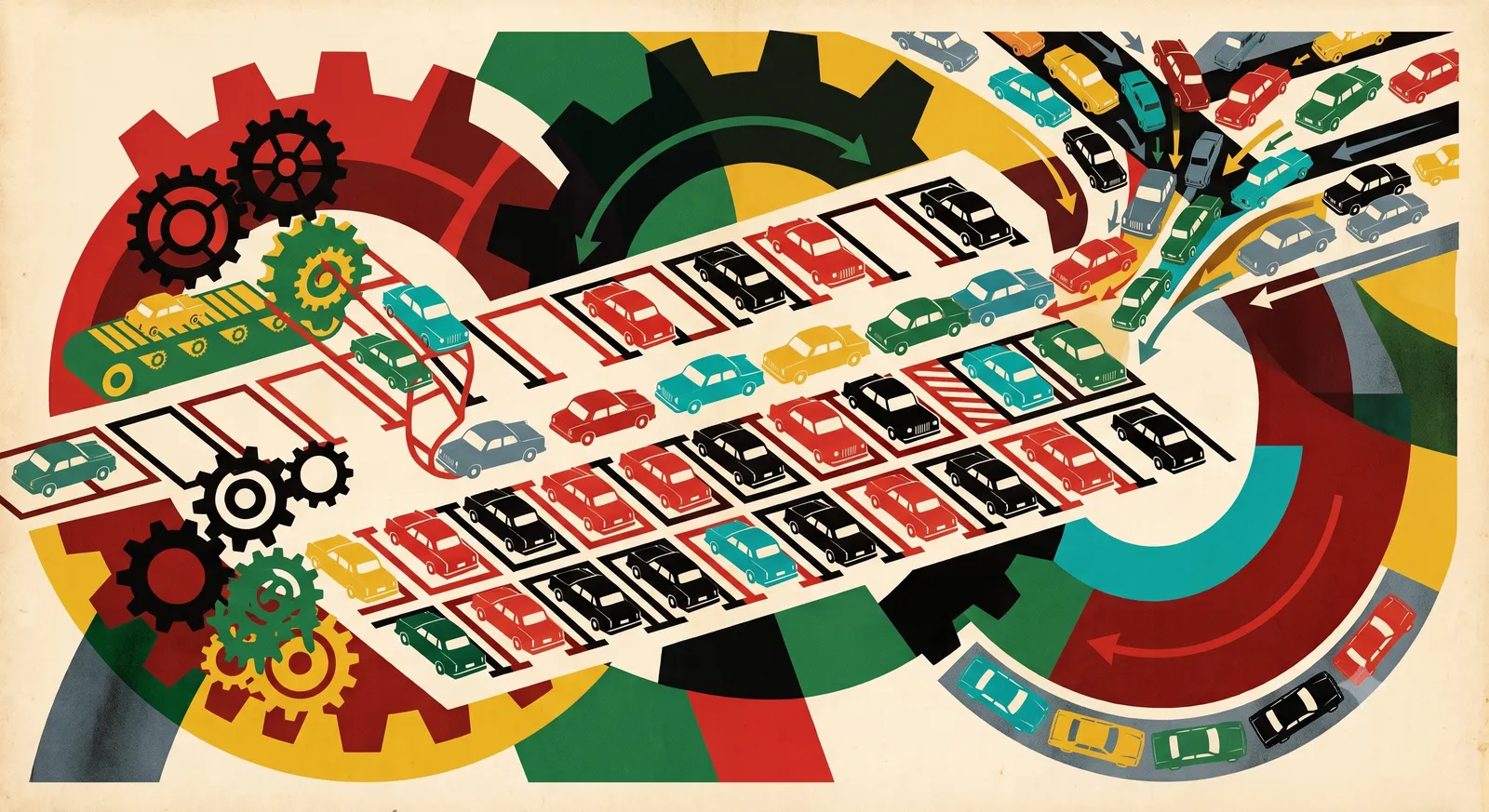
Why do the queues never shrink, even though we have been building roads for seventy years? The answer lies in one of traffic research’s most well-established and at the same time most counterintuitive phenomena: induced demand.
What is induced demand?
The idea behind building more lanes is simple. If many cars are crowding a road, we must make the road bigger, then everyone fits and the queues disappear. It sounds obvious. It is also wrong.
When a road is widened, driving temporarily gets faster. But precisely because it got faster, more people start driving. Some who used to take the metro now take the car. Some who avoided rush hour now drive in the middle of it. Some who did not make the trip at all start making it. Some move further from work, since the commute is quick now anyway. Within a few years the new capacity has filled up, and the queue is back. The same congestion, but with more cars.
This is what is called induced demand. The road created its own traffic.
Every new lane buys a few years of breathing room. Then the traffic has caught up, and the queue is back, now with more cars in it.
The phenomenon is not a fringe theory. As early as 1994, the British government’s expert committee SACTRA established that new roads generate new traffic. The economists Gilles Duranton and Matthew Turner showed in 2011, with data from American cities, that car traffic grows at almost exactly the same rate as road capacity: build 10 percent more road and you get roughly 10 percent more traffic. They called it the fundamental law of road congestion. The conclusion is uncomfortable but clear: you cannot build your way out of car queues.
The phenomenon is recognized by the Swedish authorities too. A research report commissioned by Vägverket, the predecessor of the Swedish Transport Administration, states it outright: “Increased road capacity creates new traffic. This phenomenon is called induced traffic and has long been known and recognized by international research.”
The channel Not Just Bikes made perhaps the most widely shared explanation of the phenomenon in 2024. Watch it, it is both funny and instructive.
The world’s widest traffic jam
The most famous example is the Katy Freeway in Houston, Texas. When its expansion was completed in 2008 it had up to 26 lanes, at a cost of almost 3 billion dollars. The world’s widest motorway would solve Houston’s queues once and for all.
A few years later the queues were back. Between 2011 and 2014 travel time in the morning rush increased by 30 percent and in the afternoon rush by 55 percent: a 42-minute commute had become a 64-minute one. The capacity had induced so much new traffic that the gain was eaten up within a couple of years.
But we do not need to go to Texas. When Södra länken opened in Stockholm in 2004 it was going to relieve the inner city and the southern suburbs. A little over a year later, close to 90,000 vehicles per day were passing through and the queues were a fact. The city’s own environmental analysis noted that part of the traffic was entirely new: trips that were not made before the tunnel existed, or that had shifted over from public transport. The road had created its own demand, exactly as the research predicts.
Why is it so hard to believe?
Induced demand feels wrong because we think of traffic as a fixed quantity, like water in a pipe. If the pipe is too narrow you make it wider, done.
But traffic is not water. Traffic is people making decisions. Every morning, hundreds of thousands of Stockholmers choose how, when and whether to travel. Those choices are shaped by how long the trip feels. Make the car trip easier and more people choose the car. Make it more cumbersome and more people choose something else. The amount of traffic is never a given, it is the sum of all these choices, and it adapts to the supply.
A better analogy than the water pipe: a bigger wardrobe never leads to more space in the wardrobe. It fills up. More lanes work the same way.
The phenomenon works in the other direction too
Here is where it gets really interesting. If added capacity creates traffic, what happens when capacity is removed?
Intuition says chaos: the same volume of cars must squeeze through fewer lanes, or take detours through the neighborhood streets. But since traffic consists of choices, not of a fixed volume of water, something else happens. Some drivers switch modes. Some travel at other times. Some choose closer destinations or combine errands. Some of the traffic simply disappears. The phenomenon is called traffic evaporation.
The researchers Sally Cairns, Stephen Atkins and Phil Goodwin reviewed over 70 cases in eleven countries where road capacity had been removed. In the great majority of cases, total traffic in the area decreased. On average, about a fifth of the traffic disappeared, and the feared gridlock in the surroundings almost always failed to materialize. Their dry summary of what local traffic engineers reported: a good deal of the traffic seems to have disappeared, and we do not quite know where it went.
The same Swedish report quoted above draws the same conclusion: “It is as wrong to believe that traffic volumes stay the same when capacity is reduced as it is to not expect increased road capacity to increase the total volume.”
In this short video, The Guardian explains why bike lanes rarely create the queues critics warn about, with London as the example.
The Swedish showcase: the congestion charge
Sweden’s clearest evidence that car traffic adapts to conditions is Stockholm’s congestion charge.
When it was introduced in 2006, car traffic across the charging cordon fell by around 20 percent, more than the forecasting models had predicted. Queue times in the afternoon rush were halved. And the traffic never came back: twenty years later it is still at roughly the same level, even though Stockholm has meanwhile grown by hundreds of thousands of inhabitants.
When the charge was raised in 2016 and congestion charging was introduced on Essingeleden as well, traffic fell further, and the period of worst congestion on the route shrank by up to an hour.
A hundred thousand car trips a day disappeared, and Stockholm kept functioning. No societal collapse, no wiped-out suburbs. The trips were made in other ways, at other times, or turned out not to be needed. That is traffic evaporation at full scale, in the middle of our own city.
The trend is visible even without the charge. The number of vehicle passages in Stockholm’s city center has fallen by 45 percent since measurements began, while cycling has increased by around 60 percent in ten years. When the city makes room for other ways of traveling, people travel in other ways.
Induced demand is not always bad
One last point, and perhaps the most important: induced demand is not a property of cars. It is a property of people. It applies to every way of traveling.
Build safe, coherent bike lanes and more people start cycling, including people who would never have cycled in mixed traffic. Improve public transport and more passengers come. The mechanism is exactly the same as on the motorway: make a mode of travel easier and more people choose it.
The difference is what we get in the bargain. Induced car traffic brings more congestion, more noise, worse air and more dangerous streets. Induced cycling and public transport bring healthier residents, quieter streets and, in fact, better mobility for those who genuinely must drive. Every person drawn over to the bike or the metro is one car fewer in the queue.
So the question is not whether we should induce demand. Everything we build induces demand for something. The question is what we want more of.
Common objections
“Doesn’t the traffic just move to other streets?” Some of it does, in the short term. But in the studies of over 70 capacity reductions, less than half of the traffic showed up on surrounding streets, and the feared chaos almost always failed to appear. The rest evaporated.
“That may work abroad, but not here.” The strongest example in the international research is Swedish: Stockholm’s congestion charge is cited around the world precisely because the effect was large, lasting and carefully measured.
“But what about the queues right after a rebuild?” Evaporation takes time, typically one to three years, because people need time to change habits, routes and sometimes where they live and work. Judging a street rebuild by the first few months of queues is like judging a renovation by what the home looks like while the painters are still in it.
Read more
- Duranton & Turner (2011), The Fundamental Law of Road Congestion, American Economic Review
- Cairns, Atkins & Goodwin (2002), Disappearing traffic? The story so far
- Vägverket (2009), Att hantera inducerad efterfrågan på trafik, report 2009:8 (in Swedish)
- ITF/OECD (2018), Long-Term Effects of the Swedish Congestion Charges
Read next
How much space does parking take in Stockholm?
We converted the traffic office's 125,000 on-street spaces into area: 187.5 hectares. Here are the figures, what they build on and why they differ.
5 min readHow big is a parking space? The bay is 12.5 square meters
The bay is 2.5 by 5 meters, that is 12.5 square meters. With maneuvering space included, a spot is closer to 15 or 25. Here are the measurements and where they come from.
4 min readRörstrandsgatan
Rörstrandsgatan has led Stockholm's summer street movement since 2016 and is now pedestrian year-round. A guest post by Irena Toljan on what business owners thought before and after, what the safety surveys show, and why there is still too much traffic.
5 min read